
With two weeks until the midterms and big changes likely in Washington, pundits are busy forecasting what a Democratic House, and possibly Senate, would mean for President Trump’s final two years. My own bet is that Republicans hold the Senate. It’s a fun exercise to debate how much oversight is coming; how bitter the partisan fighting will get and where the two sides might find common ground. But federal races aren’t the only ones companies, industries and nonprofits should be watching.
Like every midterm, 2026 is a referendum on the party in power. Voters, especially independents, are frustrated with an all-Republican Washington, and affordability is top of mind. That mood also is shaping the 36 governor’s races on the ballot, with consequences that will last for years. The incoming class of state leaders gives stakeholders a real opening to engage and educate on policy and regulation, playing both offense and defense closer to home. Governors offer another route to policy wins while Washington is headed for a grind-it-out game.
I’ve spent more than two decades on the Republican Governors Association’s National Finance Committee, and I’ve seen firsthand the value of engaging governors. They are a different breed of elected official. Many are wired to find common ground and deliver for their communities, even if that means trying something unconventional or making progress in small steps.
Governors are the chief executives of their states, with central roles in education, energy, health care, economic development, workforce and the business climate. They can’t walk away from a problem, and that gives stakeholders a chance to make the case for fresh approaches. With support from congressional Republicans, the Trump administration has pushed more regulatory and fiscal control to the states. That shift has strained state budgets, especially in health care, but it also has given governors more freedom to make choices that fit their states.
This year, the scale of change is even bigger than the raw number of races suggests.
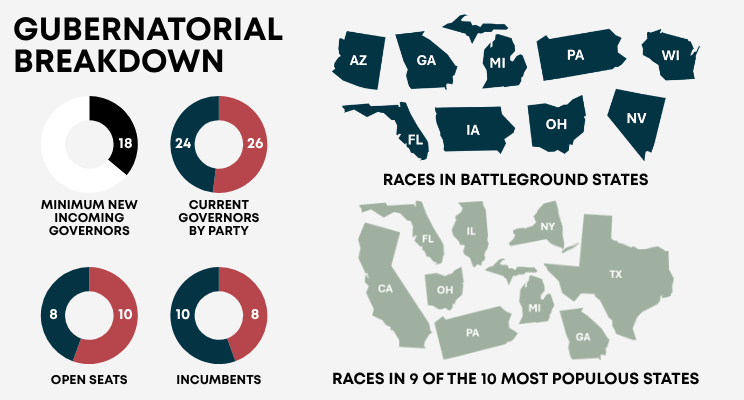
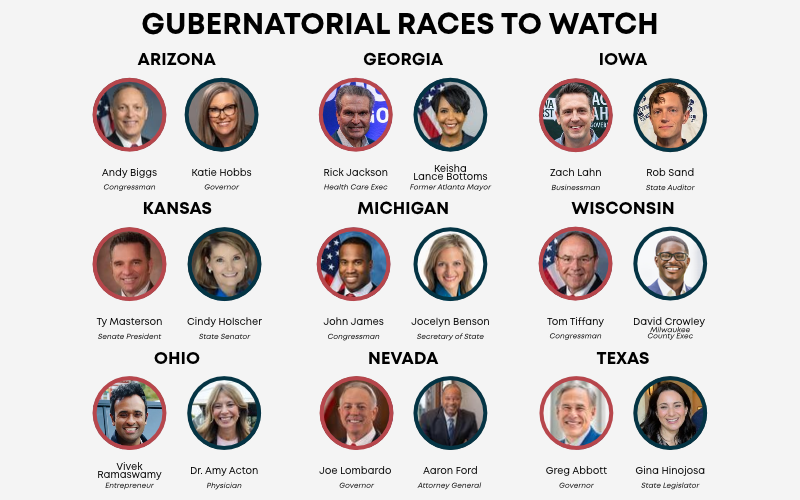
Governors set the tone and political mood in their states, and that matters most in the run-up to a presidential election. Georgia, Florida, Wisconsin, Michigan, Ohio and Iowa all have open governor’s offices this year, ending administrations that began in 2017 or 2019. How the new governors perform in their first two years will shape the 2028 climate, creating headwinds or tailwinds for their party’s nominee. With both parties expected to field a record number of presidential hopefuls, a key governor’s endorsement can open doors to donors and voting blocs and help a candidate navigate the state’s politics.
Which races should you watch? Here’s a cheat sheet.
If polls, pundits and history are any guide, change is coming to Washington. Since World War II, the president’s party has lost House seats in 18 of 20 midterms. That points to divided government, with few compromises reaching President Trump’s desk. Does that mean policy opportunities are dead? No. A term-limited president is always looking for legacy wins, so don’t close the door on Washington. But it does mean having a Plan B and a Plan C, and the states are a good place to build them.
Like rush-hour traffic, gridlock will always be with us, but there always are alternate routes, and governors are among the best of them. They are built to deliver for constituents and make their mark, especially when a strong record can open a path to the biggest prize of all, the White House in 2028.
Randall Gerard is a managing director at Cogent Strategies, where he brings two decades of Republican strategy experience to clients working in Washington. He is a member of the Republican Governors Association’s National Finance Committee and is a former Senate Commerce Committee staffer.